Raising bilingual kids
How to teach your child Urdu at home (even if your Urdu is rusty)
A calm, practical plan for parents outside Pakistan: start with speaking, keep it to five minutes, make Urdu useful at home, and let Nani and Dada be the reward. Audio for every phrase.
If your children understand some Urdu but answer in English, you’re in good company. It’s one of the most common things parents in Pakistani families outside Pakistan write about online. The good news: you don’t need a perfect accent, a tutor or an hour a day. You need small, regular moments where speaking Urdu is easy and useful.
Here’s the plan we use at home.
1. Start with speaking, not the alphabet
Children learn to talk years before they learn to read. Urdu is no different. Begin with phrases your child can say today, not letters they’ll need in five years. Reading Urdu script is a wonderful goal, but it’s a separate project, and it goes much faster once a child can already speak.
So skip the alif-bay-pay for now. Start here:
- Assalam-o-Alaikum السلام علیکم (Peace be upon you (hello)) and the reply Wa Alaikum Assalam وعلیکم السلام (And peace be upon you (hello back))
- Aap kaise hain? آپ کیسے ہیں؟ (How are you?) and the answer Main theek hoon میں ٹھیک ہوں (I am fine)
- Shukriya شکریہ (Thank you)
2. Pick ten phrases you’ll actually use this week
Long word lists don’t stick. Phrases you use every day do. Choose a handful that fit your family’s routine and use them on repeat:
| When | Phrase |
|---|---|
| Snack time | Mujhe paani chahiye مجھے پانی چاہیے (I want water) |
| Snack time | Mujhe bhook lagi hai مجھے بھوک لگی ہے (I'm hungry) |
| Offering food | Kya chahiye? کیا چاہیے؟ (What would you like?) |
| Come here | Aao آؤ (Come) |
| Sit down | Baitho بیٹھو (Sit) |
| Getting dressed | Jootay pehno جوتے پہنو (Put on your shoes) |
| Saying goodbye | Allah Hafiz اللہ حافظ (Goodbye) |
| Praise | Bohat acha! بہت اچھا! (Very good!) |
Phrases with a play button have Bulbul’s narration. You can try a few more words with audio here, and hear the rest in the app.
3. Make Urdu useful
Children speak the language that gets them what they want. So build Urdu into moments where it matters:
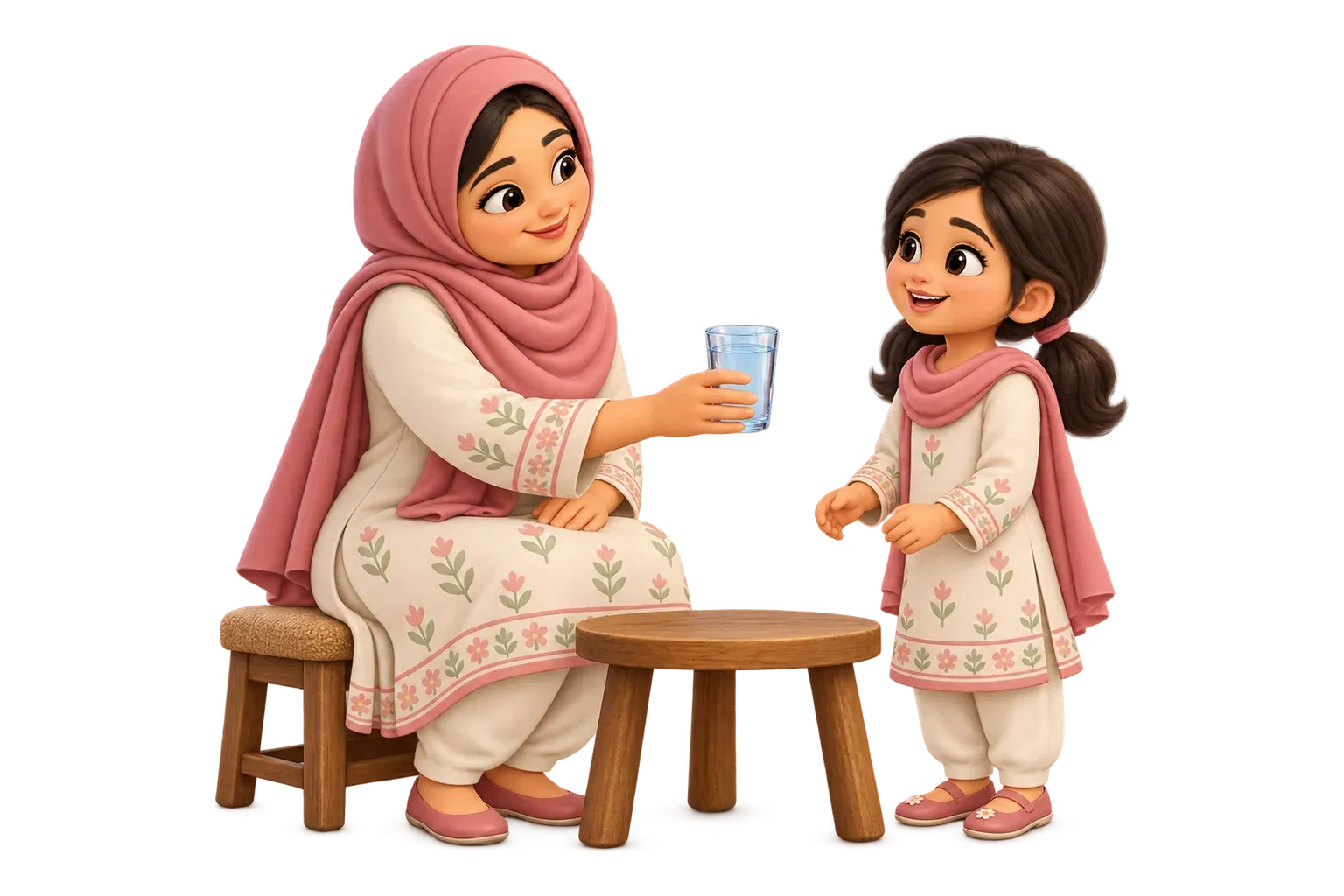
- Wait a beat at snack time. Before you pour, pause and let them ask: Mujhe paani chahiye مجھے پانی چاہیے. If they need help, say the first word and let them finish.
- Give instructions in Urdu. Aao آؤ, Baitho بیٹھو, Jootay pehno جوتے پہنو. Following an instruction is understanding, and understanding comes before speaking.
- Name the family. Look at photos and name everyone: Nani, Dada, Khala, Chacha. Our guide to Urdu family words explains who’s who.
4. Five minutes, every day
A little every day beats a lot once a week. Five minutes before dinner, in the car or at bath time is enough to keep Urdu in your child’s mouth, not just their ears. Pick the same moment each day so it becomes a habit rather than a chore.
5. Praise the try, and say it back the right way
When your child says something half in English, that’s progress. Don’t stop them to correct it. Say it back the right way, warmly, and move on:
Child: “Mujhe water chahiye.” You: “Achha, Mujhe paani chahiye مجھے پانی چاہیے Yeh lo!”
They hear the full sentence, feel successful, and get their water. Saying “no, that’s wrong” teaches only that Urdu is risky.
6. Let grandparents be the reward
The best motivation isn’t a sticker chart. It’s Nani’s face when her grandchild says Aap kaise hain? آپ کیسے ہیں؟ on a video call. Before each call, practise one new phrase together, then let your child surprise them.
7. Your Urdu doesn’t need to be perfect
Many parents worry their own Urdu is rusty or mixed with English. That’s fine. Your child needs to hear Urdu often and be invited to use it; they don’t need you to be a teacher. Use recordings for the pronunciation, and use your own voice for the everyday moments. Learning alongside your child is a great way to bring your own Urdu back.
Where Bulbul fits
We built Bulbul for exactly this. It’s an iPhone and iPad app where Bulbul the songbird teaches spoken Urdu in five-minute lessons: your child hears a phrase, finds it among pictures, then says it out loud while Bulbul listens. Every lesson ends with a small idea for you to try at home, like the snack-time pause above. See how Bulbul teaches, or try a 30-second lesson right now.
Questions parents ask
What age should I start teaching my child Urdu?
Whenever you're ready. Many families start with greetings and family words as soon as their child is talking. The years when school starts are when many children switch to English, so that's a good time to make speaking Urdu a small daily habit.
Should my child learn to read Urdu first?
No. Start with speaking. Children learn to talk long before they read, and a child who can say a sentence will find it much easier to read later. Roman Urdu can be a bridge for older children; the Urdu script is a project of its own.
How long does it take?
It depends on how much Urdu your child hears and uses each day. Instead of a deadline, watch for small wins: the first time they ask for water in Urdu without help, or answer Nani on a call.