Raising bilingual kids
My child understands Urdu but won't speak it: what actually helps
Why understanding comes before speaking, what research on bilingual families says, and seven gentle ways to get your child answering in Urdu, with audio for every phrase.
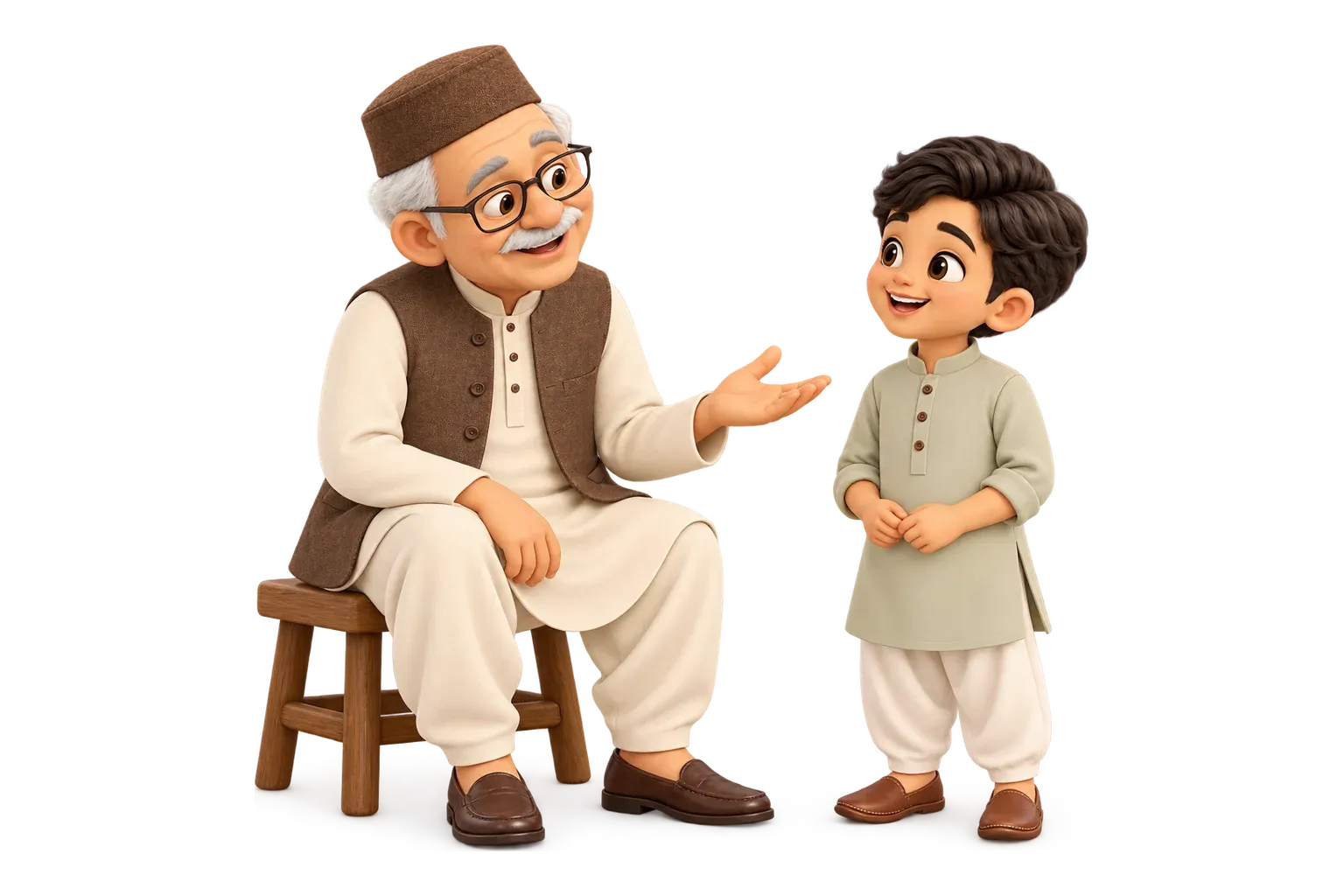
It’s the sentence that comes up in parent forums more than any other: “They understand everything, but they answer in English.” Nani asks Aap kaise hain? آپ کیسے ہیں؟ (How are you?), and the answer comes back: “Good.”
If that’s your house, nothing has gone wrong. Here’s why it happens, and what helps.
Why it happens
Understanding and speaking are different skills. A child can follow a whole conversation in Urdu long before they can put an answer together themselves, because speaking needs practice: finding the words, building the sentence and saying it out loud.
Meanwhile, English gets easier every day. School, friends, TV and often brothers and sisters all run in English. Children are practical. When everyone understands English, English is the shortcut.
What research on bilingual families says
Researcher Annick De Houwer surveyed 1,899 bilingual families in Flanders, Belgium. In nearly a quarter of them, no child spoke the home language, even though a parent did (De Houwer, 2007, Applied Psycholinguistics).
The pattern that mattered most was how much the home language was used at home. As psychologist François Grosjean summarises the same study, when both parents used only the home language, it was passed on in 97% of families, compared with 74% when each parent stuck to one language (Grosjean, Psychology Today, 2014).
You don’t need perfect conditions. The lesson is simpler: more everyday Urdu, with more chances to answer, makes the difference.
Seven things that help
1. Make Urdu needed
Children speak the language they need. Ask questions that need an Urdu answer, at moments that matter to them: Kya chahiye? کیا چاہیے؟ (What would you like?). Then wait.
2. Accept mixed answers, then say it back
“Mujhe water chahiye” is a win. Don’t correct it; say it back in full Urdu and hand over the water: Mujhe paani chahiye مجھے پانی چاہیے
3. Build sentences in pieces
Long sentences feel impossible to a small child. Build them up: Mujhe مجھے … Paani پانی … Chahiye چاہیے. Then the whole sentence.
4. Keep it short and daily
Five minutes of speaking a day beats an hour of drills on Sunday. Short, happy and regular wins.
5. Use routines
Pick a few Urdu-only moments: getting dressed (Jootay pehno جوتے پہنو), dinner, bedtime. Routines make Urdu automatic instead of a choice.
6. Give them an audience
Grandparents are the best reason to speak. Practise one phrase before a video call, then let your child say it to Nani and Dada.
7. Never make it a test
Praise every try, whatever the accent. Pressure and correction make children stop trying. A Bohat acha! بہت اچھا! does far more than a “no, say it properly”.
“Will Urdu confuse my child?”
No. ASHA (the American Speech-Language-Hearing Association) says in its guide for families that using more than one language doesn’t confuse children or cause speech or language delays (Learning More Than One Language). If you’re concerned about your child’s speech in general, in any language, that’s worth raising with your pediatrician.
How Bulbul helps
We built Bulbul around this exact gap. In five-minute lessons, children hear a phrase from Bulbul the songbird, understand it through pictures and family moments, then say it out loud, built up piece by piece. Bulbul listens and cheers every try, and never says “wrong”. After each lesson, you get one small idea to practise together that evening. Try a 30-second lesson or read how Bulbul teaches.
Questions parents ask
Is it normal for a child to understand Urdu but not speak it?
Yes. Understanding usually comes first, and many children in English-speaking countries switch to English once school starts. With regular, low-pressure chances to speak, children can move from understanding to speaking.
Will speaking Urdu at home confuse my child or delay their English?
No. ASHA's guide for families says using more than one language doesn't confuse children or cause speech or language delays. If you're worried about your child's language development in general, talk to your pediatrician or a speech-language therapist.
Should I stop speaking English to my child?
You don't have to go all or nothing. More Urdu at home helps, so pick moments that are Urdu-only (meals, bedtime, the car) and keep them warm and easy.